Aevo defi Is a Practical Guide to Perpetual ETH Trading
Aevo defi Is a way to access crypto derivatives markets, especially ETH perpetual trading, through a DeFi-style trading venue where users connect a wallet, manage collateral, place leveraged positions, and monitor fees, funding, and liquidation risk. It is best understood as a specialized trading interface rather than a simple token swap app, so users should verify current market rules, costs, and eligibility with official sources before committing funds.
Aevo defi matters because perpetual contracts are popular with traders who want exposure to ETH price movement without directly buying or selling spot ETH each time. The experience can feel familiar to anyone who has used a centralized futures exchange, but the workflow depends on wallet security, collateral deposits, order execution, and the protocol's current market design. That combination creates flexibility, but it also creates risk that should be understood before the first trade.
What is Aevo defi?
Aevo defi is commonly searched by users who want to understand whether Aevo is a decentralized exchange, a derivatives venue, a perpetual futures app, or a broader crypto trading product. In practical terms, Aevo defi refers to the use of Aevo for DeFi-oriented derivatives trading, with ETH perpetuals often serving as the clearest example of the product. A perpetual contract tracks the price of an underlying asset without a fixed expiry date, so a trader can hold a long or short position as long as margin requirements are met.
Aevo defi should not be treated as the same thing as a simple spot market. In a spot trade, the user exchanges one asset for another and owns the resulting token directly. In an ETH perpetual trade, the user is taking a contract position whose value rises or falls with ETH price movement. The difference matters because leverage, funding payments, collateral requirements, and liquidation thresholds can change the result even when the market move looks small.
The protocol is part of the wider DeFi derivatives category, which sits beside decentralized spot exchanges, lending markets, liquid staking, options protocols, and yield vaults. Aevo defi is more focused on active trading than passive holding. That makes it useful for certain strategies, but it also means the user must pay closer attention to price volatility, position size, and execution details.
How does Aevo defi work for ETH perpetuals?
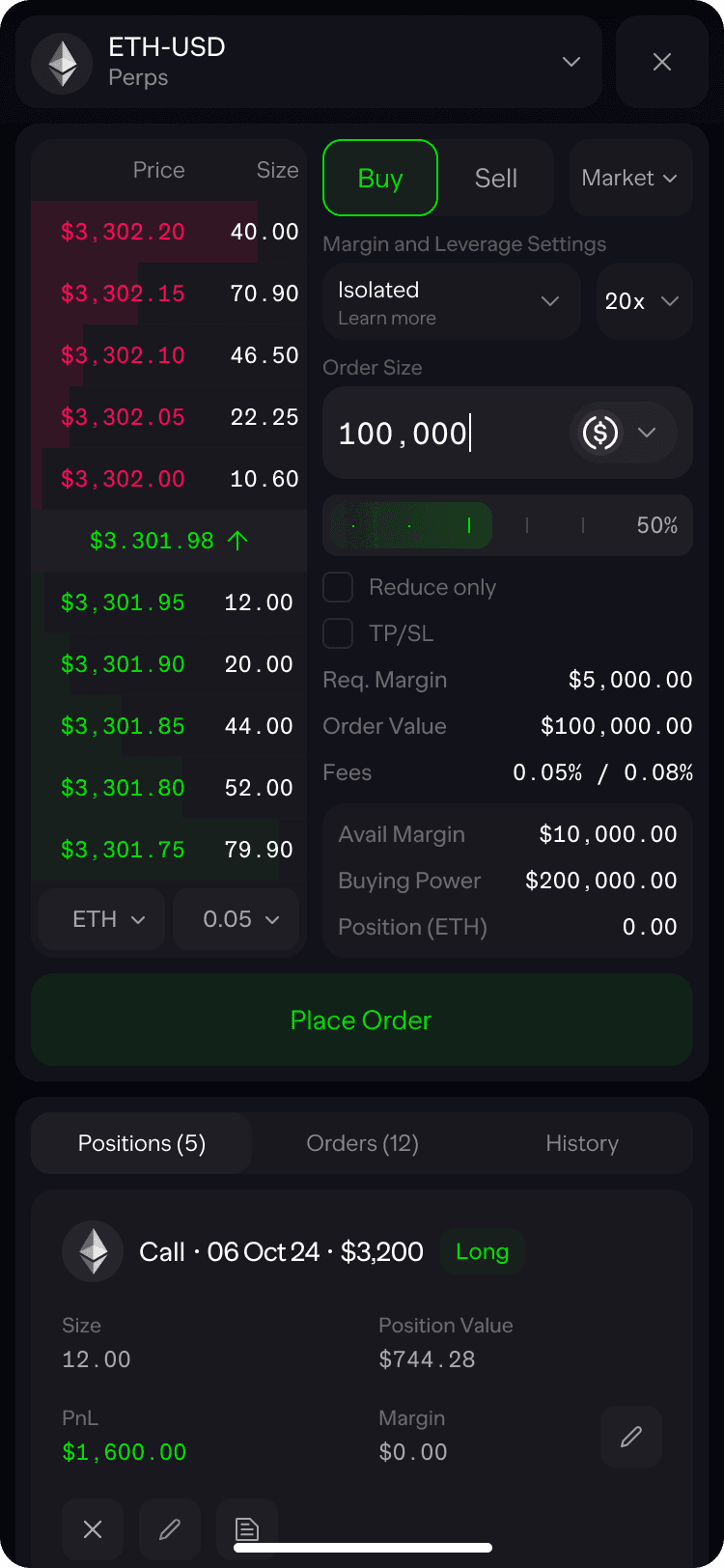
Aevo defi works by letting a user connect a crypto wallet, deposit supported collateral, choose a market such as ETH perpetuals, and open a long or short position. A long position benefits when the market price rises, while a short position benefits when the market price falls. The app interface usually presents order entry, leverage, available margin, estimated liquidation level, open positions, and trading history in one place.
Aevo defi trading depends on several moving parts. Collateral supports the trade, margin determines how much loss the position can absorb, and leverage changes the size of market exposure relative to the user's deposited funds. Funding rates may also apply because perpetual contracts need a mechanism that keeps the contract price close to the underlying index price. If funding is positive or negative, traders on one side of the market may pay traders on the other side.
In practice, Aevo defi is easiest to understand through an ETH example. A trader who expects ETH to rise might open a long ETH perpetual position with limited leverage and a defined amount of collateral. If ETH rises, the position gains before fees and funding. If ETH falls, the position loses value. If the loss approaches the liquidation threshold, the position may be closed automatically to protect the market from undercollateralized debt.
Users comparing workflows can also read broader before using a live market. Aevo defi may be intuitive for experienced crypto traders, but first-time users should slow down and understand every number in the order preview. The trade size, collateral currency, estimated fees, funding exposure, and liquidation price are all part of the decision.
Why do traders use Aevo defi?
Aevo defi attracts attention because perpetual markets can support directional trading, hedging, and more advanced portfolio management. A user who holds spot ETH may use an ETH short as a hedge. A user with a market view may use a long or short position without moving in and out of spot holdings. Some traders also value derivatives because they can adjust exposure quickly when market conditions change.
Aevo defi can also appeal to users who prefer wallet-based access rather than a conventional account structure. DeFi applications typically let users interact through self-custody wallets, though the exact custody, settlement, and account model can vary by protocol and should be checked carefully. The benefit is control and direct interaction with crypto infrastructure. The tradeoff is that a user is responsible for wallet hygiene, transaction approvals, network costs, and operational mistakes.
For a new user, the most realistic benefit of Aevo defi is not a promise of profit. It is the ability to study how a crypto derivatives venue organizes ETH exposure, collateral, and risk. Perpetual trading can be efficient, but efficiency cuts both ways: gains and losses can both happen quickly. Users should avoid interpreting reward programs, token incentives, or social posts as a substitute for understanding the mechanics.
How to get started with Aevo defi
Aevo defi should be approached as a sequence of checks rather than a single button click. Before trading, a user should confirm that the official app is being used, that the wallet is secure, that the network and collateral requirements are understood, and that the trade size is small enough to tolerate a complete loss. This is especially important for users exploring ETH perpetuals for the first time.
A careful Aevo defi workflow usually looks like this:
Visit the official application through a verified path and avoid copied links from untrusted messages.
Connect a wallet with only the funds needed for the intended activity.
Review supported collateral, deposit rules, and any network transaction costs.
Select the ETH perpetual market and inspect price, spread, funding, and liquidity.
Enter a small order, review leverage and liquidation price, then confirm only if the risk is acceptable.
Monitor the open position, funding changes, margin balance, and exit plan.
Aevo defi users should also understand that claiming tokens, moving funds, or bridging assets can introduce extra costs. In some cases, gas fees or withdrawal costs can be large relative to a small account balance. That means a small promotional reward or trading rebate may not be worthwhile after transaction costs. The practical lesson is simple: calculate total cost, not just headline reward value.
Anyone learning the collateral side can review to understand why margin and liquidation levels matter. Aevo defi becomes much easier to evaluate when the user can distinguish wallet balance, deposited collateral, available margin, unrealized profit and loss, and withdrawable funds.
What fees and costs can affect Aevo defi trades?
Aevo defi costs can include trading fees, spreads, funding payments, network fees, deposit or withdrawal costs, and the opportunity cost of holding collateral in one venue instead of another. The exact numbers can change, so users should always verify the current fee schedule and market rules in the official interface or documentation. A low visible trading fee does not automatically mean the full cost of a position is low.
Aevo defi traders often focus on maker and taker fees because those are easy to see at order entry. However, the spread between bid and ask prices can matter just as much for frequent traders. Funding can also become meaningful when a position stays open for longer. A trade that looks profitable on price movement alone may become less attractive after funding and execution costs are included.
Aevo defi can be especially sensitive to account size. A larger account may absorb fixed network costs more easily, while a small account can lose a meaningful percentage to deposits, withdrawals, or claims. This does not mean small users cannot learn, but it does mean they should avoid overtrading and should not chase token incentives without calculating the full path in and out of the platform.
Is Aevo defi safe?
Aevo defi involves several categories of risk, and safety depends on both the protocol design and the user's behavior. Market risk is the most obvious: ETH can move sharply in either direction. Leverage magnifies that movement, so a small price change can cause a large gain or loss. Liquidation risk appears when collateral is no longer sufficient to support the open position.
Aevo defi also includes smart contract, operational, oracle, liquidity, and user-security risks. A bug, delayed price feed, thin order book, phishing site, malicious approval, compromised wallet, or mistaken network selection can all lead to losses. Even when the protocol operates normally, the user can still lose money by using too much leverage or holding a position through extreme volatility.
The safest way to approach Aevo defi is to treat every trade as risky capital. Users should verify the official app, use strong wallet security, keep approvals limited when possible, avoid signing unclear transactions, and test with small amounts before increasing size. None of this eliminates risk. It simply reduces avoidable mistakes. Aevo defi is a financial trading environment, not a guaranteed income tool.
How does Aevo defi compare with other DeFi markets?
Aevo defi belongs to the decentralized derivatives family, while many other DeFi products focus on spot swaps, lending, staking, or automated yield strategies. A decentralized spot exchange is usually better for users who simply want to exchange tokens. A lending market is more relevant for borrowing or earning variable interest. A derivatives venue such as Aevo defi is designed for active exposure, hedging, and leveraged trading.
Aevo defi may also be compared with centralized futures exchanges. Centralized venues can offer deep liquidity, many pairs, and familiar account controls, but they require users to trust the exchange with custody and account access. DeFi venues can offer wallet-based interaction and more transparent onchain components, but users must handle more operational responsibility. Neither model is automatically better for every trader.
The important comparison is not only brand versus brand. It is product fit. Aevo defi may make sense for a user who understands perpetual contracts, wants ETH exposure, and can manage collateral carefully. A spot DEX or simple wallet swap may be more appropriate for someone who only wants to buy ETH without leverage. A lending protocol may be more suitable for users focused on borrowing or supplying assets rather than trading directionally.
What should users know before trading on Aevo defi?
Aevo defi requires a trading plan. A user should know the reason for entering a position, the maximum acceptable loss, the liquidation level, the expected holding period, and the exit conditions. Without those decisions, the interface can encourage reactive trading. Volatile ETH markets make that especially dangerous because a position can move from comfortable to distressed quickly.
Aevo defi users should be cautious with reward campaigns and token farming narratives. Incentives can reduce effective costs or add potential upside, but they can also encourage unnecessary volume, excessive risk, and poor timing. Rewards may be delayed, may require claims, may involve gas costs, and may change according to rules that users need to verify. A trade should make sense on its own risk terms before any bonus is considered.
In addition, Aevo defi should be evaluated with tax, recordkeeping, and jurisdictional constraints in mind. Derivatives trading can create reporting obligations, and availability may differ by location. This page is informational and does not provide financial, tax, or legal advice. Users should consult qualified professionals where needed and confirm official platform rules before acting.
Where Aevo defi fits in a broader crypto strategy
Aevo defi can be a useful learning point for anyone studying how DeFi has expanded beyond swaps and lending into more sophisticated trading products. ETH perpetuals show how collateral, leverage, liquidity, and price indexes come together in a live market. That makes Aevo defi relevant to traders, researchers, and users who want to understand decentralized derivatives more clearly.
Aevo defi is not necessary for every crypto participant. Long-term holders may prefer spot custody. New users may benefit from learning wallets and token transfers before touching leverage. Active traders may find value in the speed and structure of perpetual markets, but only if they respect the downside. The best use of Aevo defi begins with education, small experiments, and disciplined risk limits.
Aevo defi should ultimately be viewed as a tool. A tool can support a well-defined strategy, but it cannot replace judgment. Before using Aevo defi, confirm official details, understand the collateral model, read the current fee information, and assume that losses are possible. With that mindset, users can evaluate ETH perpetual trading more realistically and avoid treating DeFi markets as simpler than they are.
Reader rating:
4.8 / 5
based on 582 ratings
Questions and Answers
What is Aevo defi used for?
Aevo defi is used to access DeFi-style crypto derivatives markets, especially perpetual contracts such as ETH perpetuals. Users can connect a wallet, deposit supported collateral, and trade long or short exposure to an underlying crypto asset. It is not the same as buying spot ETH, because perpetual trading involves margin, funding, liquidation risk, and changing market conditions.
Is Aevo defi the same as a spot exchange?
No. Aevo defi is better understood as a derivatives trading venue, while a spot exchange is mainly used to swap one asset for another. In a spot trade, the user owns the token received. In a perpetual trade, the user holds a contract position tied to price movement. That distinction matters because leverage and liquidation can affect outcomes quickly.
Can beginners use Aevo defi safely?
Beginners should be very cautious with Aevo defi because perpetual contracts are more complex than simple token swaps. A safer learning approach is to study collateral, margin, funding rates, liquidation prices, and wallet security before placing any trade. If a user experiments, small amounts and careful order review are more appropriate than high leverage or reward chasing.
What costs should I check before using Aevo defi?
Before using Aevo defi, check trading fees, bid-ask spreads, funding rates, deposit costs, withdrawal costs, claim costs, and any network gas fees. The exact numbers can change, so they should be verified in official platform materials and the live trading interface. Small accounts can be especially affected by fixed transaction costs.
Does Aevo defi guarantee rewards or profit?
No. Aevo defi does not guarantee profit, and any reward campaign should be treated as uncertain until official rules are verified and rewards are actually received. Trading can create losses that exceed the value of incentives. Users should calculate total costs, understand the risk of liquidation, and avoid making trades only because a token reward might be available.
What is the main risk of ETH perpetual trading on Aevo defi?
The main risk is that ETH price movement, leverage, and margin requirements can cause rapid losses or liquidation. Other risks include funding costs, liquidity changes, smart contract issues, oracle problems, phishing, and wallet mistakes. Aevo defi users should only trade with funds they can afford to lose and should verify all current details through official sources.
O LinkedIn e terceiros usam cookies essenciais e não essenciais para fornecer, proteger, analisar e aprimorar nossos Serviços, e para exibir anúncios relevantes (inclusive anúncios
profissionais e com vaga
) dentro e fora do LinkedIn. Saiba mais na nossa
Política de Cookies
.
Selecione Aceitar para consentir ou Rejeitar para recusar cookies não essenciais para este uso. Você pode atualizar suas opções nas suas
configurações
quando quiser.
A IA Generativa pode fazer muito mais pelo seu programa de inovação do que você imagina.
O maior diferencial está em como ela é aplicada aos processos e integrada à estratégia da sua empresa.
No vídeo,
Luis Carvalho
, nosso CEO Global, deixa claro: durante o AEVO NEXT, você irá conhecer como os novos GenAI Apps personalizam jornadas de inovação para gerar impacto real.
Marque na agenda: 07 de abril | 14h | Online e Ao Vivo.
Não perca tempo e garanta sua vaga gratuita agora no link disponível nos comentários.